
Mining Incentives Increase as Fee Markets Exceed Block Rewards on the Bitcoin SV Network


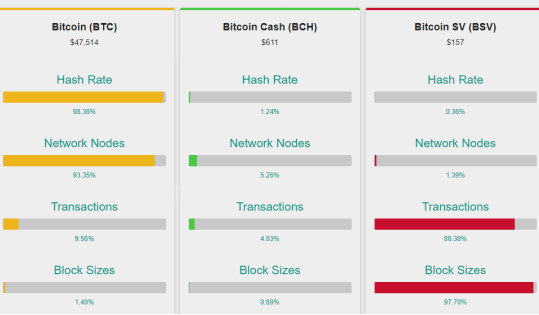
Of the three most used Bitcoin Networks, Bitcoin SV has been experiencing an exponentially increasing amount of transactions, citing blocks as large as 2 gigabytes. Blocks at this scale have yet to be seen on any other Bitcoin networks due to scaling limitations that prevent miners from processing blocks over 1 Megabyte on the BTC network and 32 Megabytes on the BCH network. On the Bitcoin SV network, miners compete for blocks of any size. Bitcoin SV (BSV), short for ‘Bitcoin Satoshi Vision,’ claims the title given that the BSV network follows the original Bitcoin protocol in regards to scaling. In 2009, Satoshi Nakamoto, the founder of Bitcoin quoted:
“The existing Visa credit card network processes about 15 million Internet purchases per day worldwide. Bitcoin can already scale much larger than that with existing hardware for a fraction of the cost. It never really hits a scale ceiling.”
Bitcoin Miners compete for 2 streams of revenue. The first stream of revenue is the block reward. Since the inception of the Bitcoin genesis block on January 3rd, 2009, every 10 minutes a block is mined. For the first 4 years, each block reward was 50 Bitcoins, for the following 4 years the block reward halved to 25 Bitcoins. Every 4 years the block reward continues to split in half. For this reason, Bitcoin will have a complete supply of 21 million around the year 2140. Today, miners compete for a 6.25 Bitcoin Block reward.
The second stream of revenue miners compete for is the fee market. Every time a transaction is made on the Bitcoin network, the user pays a fee to the miner to process the transaction. Each transaction equates to a certain amount of data. It is currently around 3000 times cheaper and exponentially faster to send a transaction on the BSV network when compared to the BTC network. For the first time in history, blocks are being produced on the BSV network where the mining revenue from the fee market exceeds that of the block reward. Given the block reward will continue to halve in the future (in 2024 to 3.125), miners may become more reliant on the fee market for revenue, and less reliant on the block reward.
Block #700606 , consisted of 10.00141684 BSV in fees generated among miners. If BSV were to be trading at the value of BTC (~$50,000 USD at the the time of writing), miners would be competing for a $500,000 Fee market and a $312,000 block reward every 10 minutes. Because of the 1 Megabyte scaling limit enforced on BTC miners, blocks do not exceed 1MB and miners have to rely on users to pay higher fees for use of the network, these fees have never equated to anything close to a 10 BTC per block fee market for the miners. For the past year BSV block sizes have been growing exponentially relative to all other Bitcoin networks.
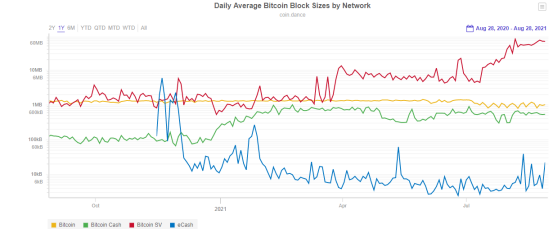
A few fundamental differences between BSV and BTC can attribute to the explanation behind the explosion in transactions on the BSV network. BSV allows for ‘OP_Return’ transactions, which allow for carrying data within a Bitcoin transaction. Having said this, numerous applications use BSV micro-transactions. These include social media platforms, gambling websites, weather applications, and even video games. Applications built on the BSV protocol are on the rise, and are infinite with unbounded scaling:


With just the one single video game: ‘Crypto Fights,’ creating 2 million transactions daily, many BSV supporters speculate the possibility for a world of Bitcoin at a much larger scale, and the quantity of fees BSV miners should expect to compete for. For years, small block advocates have continually denied the claim that scaling could be solved by increasing the block size and have continuously altered the Bitcoin protocol from its original state. These include views from Adam Back, CEO of Blockstream. BSV advocates argue otherwise.
As a result of the exponential increase of transactions on the BSV network, BSV is equating to more than 50% of all transactions for all the major digital currencies. Given the scaling limitations imposed in competing networks, BSV supporters will argue that BSV is currently the only network with the capacity to handle the scale for global adoption while continuing to support mining revenue over time through the growth of application development on the Bitcoin SV protocol.
Written By: Kurt Laengner
If you enjoyed this content. please consider sharing and subscribing to this newsletter for public and private updates.